

“Unknown” Isn’t Neutral: The Most Expensive Word in Maine Real Estate

In Maine real estate and property management, no topic creates more friction—between sellers, buyers, landlords, tenants, agents, insurers, and contractors—than this one: environmental risk in old housing stock, labeled as “Unknown.”
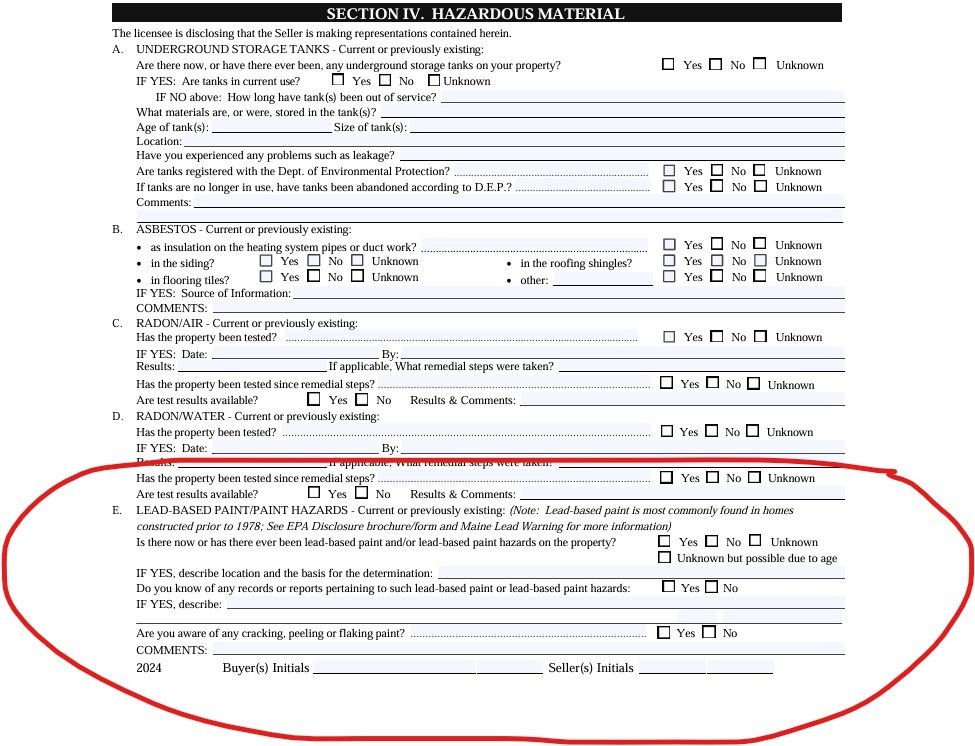
“Unknown” feels safe. It sounds cautious. It’s even technically allowed on Maine disclosure forms when information isn’t available.
Let's be honest: it's the go-to default answer when owners don't want to address potential issues with their property.
But here’s the uncomfortable truth: “Unknown” doesn’t remove risk. It transfers it. And in Maine—where a huge share of housing predates modern hazard standards—that transfer often becomes a negotiation grenade.
Why this is uniquely Maine
Maine isn’t arguing about theoretical risk. We’re arguing about probable risk, because our housing is old—often very old. One widely cited figure: about 57% of Maine’s housing stock was built before 1978, the year lead-based paint was banned for residential use.
Layer in the health stakes: Maine’s Lead Poisoning Control Act defines lead poisoning in young children at 5 µg/dL (confirmed), and the Legislature’s reporting notes that in 2023 an estimated 300 children (1.7% of tested) met that statutory definition.
Then add radon—another “quiet” risk that turns into a loud one when it shows up on an inspection report. Maine indoor air guidance commonly cites about one in three homes testing at or above EPA’s action level of 4 pCi/L, depending on region and sampling.
So when a seller or landlord marks “Unknown,” they aren’t staying out of trouble. They’re stepping into the most controversial space in Maine housing: risk management vs. plausible deniability.
A Maine case study: The deal that shifted in one question
Property: 1920s two-unit in Greater Portland
Scenario: Seller-occupied, rental unit upstairs. Cosmetic updates, but original trim and windows remain.
Disclosure: Hazardous materials marked “Unknown” for lead-based paint and radon. (Not uncommon—and permitted when information isn’t available.)
The showing goes well. The offer comes in strong.
Then the buyer’s agent asks one question that every Maine investor has learned to ask eventually:
“Has the property been tested?”
The seller’s answer is honest: No testing. No records. Just “Unknown.”
The seller's narrative: "We've lived here for years without any problems."
That single moment changes the leverage in three ways:
The buyer’s imagination fills the gap. “Unknown” becomes “worst-case,” especially for pre-1978 housing. "What if I rent it to a family with children under six?"
The lender and insurer start asking for documentation. Not always, but often enough that experienced agents plan for it.
The renovation plan stalls. If work will disturb painted surfaces, contractors and owners start thinking ahead to lead-safe practices and scheduling risk.
The buyer doesn’t walk. They counter.
Counter terms:
A credit to cover lead and radon due diligence
A longer inspection window
A contingency tied to environmental findings
Now the seller is boxed in: refuse and risk losing the deal, or test and risk learning something they didn’t want to know.
No one wants a transaction to fall apart—but uncovering environmental hazards can feel like opening Pandora’s box, especially when tenants are actively occupying the property and costs may escalate quickly.
Inspection costs. Renovation expenses. Potential lost rental income.
The “adult” move: Replace “Unknown” with evidence
The seller chooses the grown-up path: evidence.
A licensed Maine-DEP licensed inspector completes XRF lead paint testing on representative components—trim, windows, doors, walls—documenting results by component and location. (This is the key distinction: it's concrete evidence.)
The report doesn’t assign blame or create fear. It simply clarifies what’s present, where it’s located, and what it means.
Results come back mixed—exactly what you’d expect in Maine:
Several original components test lead-positive (older window trim and sash are classic)
Some later renovations test lead-negative
A handful are inconclusive, requiring retesting strategy or conservative planning
Here’s the moment that reduces controversy: the seller can now offer targeted risk management instead of blanket uncertainty. For lead-negative components (where applicable), the seller can pursue limited lead-safe documentation—not a “lead-free” promise, but a component-specific, time-of-inspection statement that lowers perceived risk when properly explained. (The word “limited” matters.)
The buyer doesn’t need perfection. They need clarity:
What’s positive?
What’s negative?
What does that mean for renovation, tenant turnover, and cost?
With documentation in hand, the negotiation shifts again—but this time in a productive direction:
The buyer keeps the deal
The seller preserves more value than a fear-based discount
The property manager inherits a plan instead of a guessing game
The HarborLight Takeaway:
In Maine, the controversy isn’t lead. It’s not radon. It’s not asbestos.
The controversy is how long we pretend that “Unknown” is a strategy.
“Unknown” is allowed on forms.
But in real transactions and real property operations, “Unknown” is a liability multiplier:
It increases negotiation volatility
It delays renovations
It invites conflict with tenants, buyers, and contractors
It often costs more than the test would have cost
If you want the investor version of this lesson:
You don’t buy risk. You buy the price of risk—plus the cost of managing it.
“Unknown” makes both numbers worse.
Until next week's Brick & Profit article!
References (for readers who want the receipts)
Maine seller disclosure law excerpt allowing “unknown” when information is unavailable
Maine housing stock pre-1978 estimate (57%)
Maine Legislature report: 2023 childhood lead poisoning (5 µg/dL definition; ~300 children; 1.7% of tested)
MaineTracking Network radon data + Maine radon policy summaries


Comments