


Know the Hazard. Control the Risk.™ Maine Lead Risk Assessments
A Maine DEP Certified Lead Risk Assessor goes beyond finding lead paint to identify the existence, nature, severity, source, and location of lead hazards—and the practical options to control them.
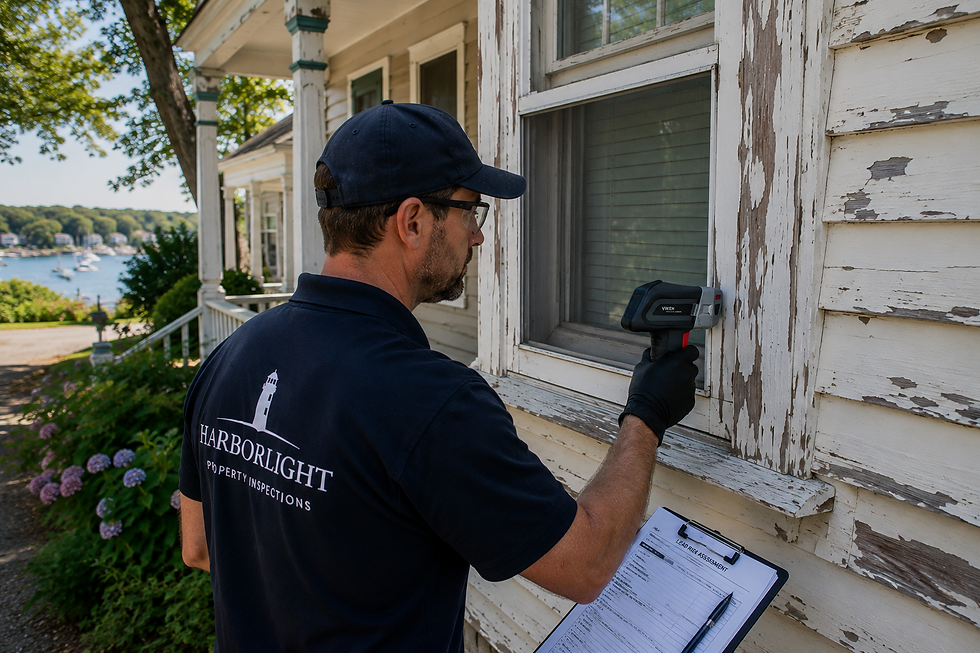
THE LEAD RISK CLARITY PLAN
A Lead Risk Assessment is not simply more testing. It is a professional decision system for understanding whether lead hazards exist, how serious they are, where exposure can occur, what is causing the condition, and which control options make sense.
THE VALUE STACK: pre-assessment scope confirmation • review of property history, existing lead records, renovations, and occupancy patterns • interior, exterior, and site visual assessment • XRF and paint analysis when required • targeted dust, soil, and water sampling as applicable • evaluation of deteriorated paint, friction and impact surfaces, structural or moisture causes, and exposure pathways • hazard prioritization • practical interim-control and abatement options • a comprehensive digital report within 48 hours • direct access to your assessor for report questions.
Every assessment is performed by Michael Marquis, Maine DEP Certified Lead Risk Assessor LR-0432 and Certified Lead Inspector LI-0526. Most onsite assessments take approximately 2–4 hours, depending on property size, condition, and sampling scope.

A Lead Risk Assessment is a comprehensive evaluation of a property's potential lead exposure hazards.
Unlike a traditional lead inspection that simply identifies where lead-based paint is present, a Lead Risk Assessment determines whether deteriorated paint, lead-contaminated dust, bare soil, friction surfaces, or impact surfaces create an actual health risk for occupants.
The assessment focuses on exposure—not simply the presence of lead.
The goal is to help property owners understand:
-
Where lead hazards exist
-
Why they present a risk
-
How occupants may be exposed
-
What corrective actions should be taken
-
Which hazards should be prioritized
Whether you own a historic home in Portland, manage multifamily housing in Biddeford, or operate a child care facility in Southern Maine, a professional Lead Risk Assessment provides the information needed to make informed decisions.

LEAD DETERMINATION VS. LEAD RISK ASSESSMENT
LEAD DETERMINATION: Chapter 424 describes this as a limited inspection of a dwelling, child-occupied facility, or defined portion of one. XRF readings and/or paint-chip analysis may be used to determine whether specified components or areas contain lead-based paint, lead-based paint hazards, or other lead hazards.
It is ideal for a focused renovation question, selected components, a defined transaction concern, or another limited scope. It does not automatically evaluate every exposure pathway or produce a whole-property hazard-control strategy.
LEAD RISK ASSESSMENT: This answers the larger question:
What conditions could expose occupants to lead, how serious are they, where do they come from, and what should be done?
A complete or targeted risk assessment evaluates the existence, nature, severity, source, and location of lead-based paint hazards and lead hazards. It can combine document review, interior and exterior visual assessment, building-condition analysis, XRF or paint analysis, dust, soil, and water sampling, occupant-use patterns, and practical control options.
THE SIMPLE DIFFERENCE: A determination identifies lead conditions within a defined scope. A risk assessment connects the lead, the building condition, the exposure pathway, the occupant, and the control plan.

WHO SHOULD CHOOSE THE DEEPER ASSESSMENT?
HOME BUYERS: When a pre-1978 property will be occupied by children, has deteriorated paint, or needs more than a component-by-component paint answer.
FAMILIES AND GUARDIANS: When the priority is understanding real exposure pathways inside and around the home.
LANDLORDS AND PROPERTY MANAGERS: When documented hazards, maintenance priorities, liability reduction, capital planning, or a defensible management strategy matter.
CHILD CARE FACILITIES AND SCHOOLS: When young children use the space and paint condition, dust, soil, friction surfaces, and common areas must be evaluated together.
MUNICIPALITIES, HOUSING PROVIDERS, AND HEALTHCARE OR SUPPORTIVE-HOUSING ORGANIZATIONS: When decisions affect multiple occupants, public funds, compliance, or long-term building stewardship.
CONTRACTORS, ARCHITECTS, AND OWNERS PLANNING RENOVATION: When the work plan needs to account for hazards, exposure pathways, and appropriate controls before disturbance begins.
CHOOSE A RISK ASSESSMENT WHEN THE ANSWER WILL DRIVE health protection, occupancy decisions, maintenance priorities, project scope, budgeting, interim controls, or abatement planning - not merely confirm whether selected paint contains lead.
THE CHAPTER 424 RISK-ASSESSMENT PROCESS
01 — DEFINE COMPLETE OR TARGETED SCOPE: A complete assessment covers the dwelling and common areas; a targeted assessment is contractually limited to a defined portion.
02 — REVIEW THE HISTORY: Existing lead reports, renovation and maintenance history, construction information, occupancy, intended use, and potential occupant exposure patterns are reviewed.
03 — INSPECT THE BUILDING AND SITE: Interior and exterior painted surfaces, surrounding land, deteriorated paint, friction and impact surfaces, bare soil, moisture entry, structural deficiencies, and substrate conditions are evaluated for causes—not just symptoms.
04 — USE THE RIGHT TECHNOLOGY: Prior lead inspections are evaluated for reliability. When a complete inspection is absent or unreliable, Chapter 424 requires the appropriate lead inspection. HarborLight uses the Viken Pb200i XRF analyzer under its HUD Performance Characteristic Sheet and documented calibration procedures; paint-chip laboratory analysis is used when required.
05 — SAMPLE EXPOSURE PATHWAYS: Dust wipes, soil samples, and water samples are selected and collected as applicable, then analyzed by properly accredited laboratories.
06 — DETERMINE HAZARD, SOURCE, AND SEVERITY: The assessor connects lead-based paint with paint condition, dust, friction, impact, soil, water, building defects, and occupant-use patterns to identify actual or potential exposure pathways.
07 — PRIORITIZE CONTROL OPTIONS: Practical recommendations may include interim controls, maintenance, monitoring, further testing, or abatement options based on hazard severity and building conditions.
08 — DELIVER THE DECISION REPORT: Within 48 hours, you receive a report that explains the findings in plain language and documents property information, the certified assessor, laboratories, methods, room-by-room lead components, hazard locations, structural or substrate causes, field and quality-control data, XRF serial number, photographs, diagrams, laboratory results, and acceptable control methods. USE THE REPORT FOR occupant protection, real-estate due diligence, maintenance planning, renovation scoping, contractor bidding, budgeting, insurance or legal documentation, municipal or institutional decisions, and a defensible hazard-management plan. Chapter 424 states that risk-assessment reports and recommendations are valid for one year and can only be changed through a new risk assessment.
LEAD RISK ASSESSMENT PRICING — CHOOSE THE DEPTH YOUR DECISION REQUIRES
Residential Lead Risk Assessment (Interior & Exterior)
Up to 1,500 Square Feet
$595
1,501 – 2,500 Square Feet
$695
2,501 – 3,500 Square Feet
$795
3,501 – 5,000 Square Feet
$895
Over 5,000 Square Feet
Custom Proposal
*Includes visual lead hazard assessment, exposure pathway evaluation, hazard prioritization, photo documentation, and comprehensive digital report.
Occupant Risk Assessment (Interior Living Areas)
Up to 1,500 Square Feet
$475
1,501 – 2,500 Square Feet
$575
2,501 – 3,500 Square Feet
$675
Over 3,500 Square Feet
Custom Proposal
*Ideal for homeowners, families with young children, and buyers seeking to understand lead exposure risks within occupied living spaces.
Multifamily & Commercial Buildings
Up to 5 Units
Starting at $895
6-15 Units
Custom Proposal
16+ Units
Custom Proposal
Schools, Childcare Facilities &
Commercial Buildings
Custom Proposal
*Pricing is based on occupancy, number of units, sampling requirements, and building complexity.
Additional Services
Dust Wipe Sampling
$25 per Sample
(Laboratory Fees Additional)
Soil Sampling
Custom Pricing
Water Sampling
Custom Pricing
Follow-Up Risk Assessment
Starting at $250
Lead Hazard Consultation
$175 per Hour
WHY THE RISK ASSESSOR CREDENTIAL MATTERS: Maine DEP’s Chapter 424 expressly treats Risk Assessor as a higher-level certification that qualifies the professional to function as a Lead Inspector. It is Maine’s most advanced lead evaluation credential: the Risk Assessor must build on inspector-level knowledge and complete Lead Supervisor, Lead Inspector, and Lead Assessor training, demonstrate qualifying education and field experience or a Department field assessment, pass the required examination, maintain annual discipline-specific refresher training, evaluate both lead conditions and exposure pathways, and recommend appropriate hazard-management strategies.
Your assessment is performed by Michael Marquis, Maine DEP Certified Lead Risk Assessor LR-0432 and Certified Lead Inspector LI-0526. His related credentials include EPA Certified Renovator, Maine DEP Certified Asbestos Inspector, IAC2 Certified Indoor Air Consultant, InterNACHI Certified Professional Inspector, and CCPIA Certified Commercial Property Inspector. That combination matters because lead risk is rarely just a paint reading—it is a building, moisture, maintenance, occupancy, and exposure problem that requires disciplined professional judgment.

Proudly Serving Southern Maine
HarborLight provides Lead Risk Assessments throughout:
Cumberland County
-
Portland
-
South Portland
-
Scarborough
-
Cape Elizabeth
-
Falmouth
-
Yarmouth
-
Freeport
-
Windham
-
Gorham
-
Westbrook
York County
-
Biddeford
-
Saco
-
Kennebunk
-
Kennebunkport
-
Wells
-
Ogunquit
-
York
Androscoggin County
-
Lewiston
-
Auburn
-
Lisbon
-
Topsham
-
Brunswick
Frequently Asked Questions
WHAT IS THE DIFFERENCE BETWEEN A LEAD DETERMINATION AND A RISK ASSESSMENT?
A determination is limited to identifying lead conditions within a defined scope. A risk assessment evaluates hazard existence, nature, severity, source, location, exposure pathways, and control options.
DOES LEAD-BASED PAINT ALWAYS MEAN AN IMMEDIATE HAZARD? No. Paint condition, friction, impact, dust, soil, water, building defects, and occupant use determine whether and how exposure may occur.
DOES EVERY PROPERTY REQUIRE A COMPLETE ASSESSMENT? No. Chapter 424 allows complete and targeted risk assessments. The right scope depends on the property and the decision you need to make.
WHAT TECHNOLOGY AND SAMPLING MAY BE USED? Depending on scope and conditions, the assessment may use calibrated XRF analysis, paint-chip laboratory testing, dust wipes, soil sampling, and water sampling.
HOW LONG DOES IT TAKE? Many assessments take approximately 2–4 hours onsite; larger, multifamily, institutional, or sampling-intensive properties may require more time.
WHEN WILL I RECEIVE THE REPORT? HarborLight’s standard goal is a comprehensive digital report within 48 hours after the onsite assessment and receipt of any required laboratory data.
HOW LONG IS THE REPORT VALID? Chapter 424 states that risk-assessment reports and recommendations are valid for one year and can only be changed through a new risk assessment.
READY TO STOP MANAGING AN UNKNOWN? Send the property address, approximate year built, occupancy, number of units, known lead history, primary concerns, and your deadline. HarborLight will confirm whether you need a determination, targeted risk assessment, or complete risk assessment—and provide the right scope and price before the visit. Know the hazard. Control the risk. Protect the occupants. Contact Michael Marquis at HarborLight Property Inspections, LLC • 207-245-4688 • mike@harborlightinspections.com

EPA's new lead dust rule lowers thresholds, strengthening hazard protection. Click here for the latest EPA standards.

Learn how asbestos exposure occurs, potential health risks, and steps to protect your family. Click here.
.jpg)
Citizen's Guide to Radon
Understand radon risks, testing methods, mitigation options, and how to protect your home. Click here.


